🛑 Errorsys - Custom error page
When an action fails, HIX renders an HTML 500 page. By default,
it displays the internal HIX_ErrorSys screen.
Errorsys allows you to replace that screen with your own
.html template, using the full HIX view engine.
Configuration
From hix.json
Path resolution
app.errorsys does not include the errors/ folder in the JSON. HIX adds it
depending on hixstyle.enabled:
hixstyle.enabled |
JSON value | Resolved path |
|---|---|---|
true |
errorsys.html |
<cRoot>/errors/errorsys.html |
true |
sub/errorsys.html |
<cRoot>/errors/sub/errorsys.html |
false |
errorsys.html |
<cRoot>/errorsys.html |
false |
sub/errorsys.html |
<cRoot>/sub/errorsys.html |
With hixstyle.enabled=true, errors/ is a fixed layout folder
(like controllers/, views/, models/) and is always prefixed.
<cRoot> comes from paths.root in hix.json (default: www).
Flow:
1. If the template exists and renders without error → it is sent to the client.
2. If the template fails to render → the Errorsys Design Error page is shown
(dark red background) with the original error plus the template's error.
3. If the template does not exist or is empty → falls back to the internal renderer
(HIX_ErrorSys, which in turn respects app.env).
The errorsys.html template
It is a standard HIX template — same @args, {{ }}, and rules as
any .html file.
It receives a single parameter hError (hash) with the error fields:
@args hError

<!DOCTYPE html>
<html lang="en">
<head>
   <meta charset="UTF-8">
   <title>Error {{ hb_NToS(hError['subCode']) }}</title>
   <link href="https://cdn.jsdelivr.net/npm/bootstrap@5.3.3/dist/css/bootstrap.min.css" rel="stylesheet">
   <style>
      body { padding: 2em; font-family: system-ui, sans-serif; }
      pre  { background: #f4f4f4; padding: 1em; }
   </style>
</head>
<body>
   <h1 class="text-danger">Application Error (DEV)</h1>
   <hr>
   <table class="table table-bordered">
      <tr><th>Time</th><td>{{ dtoc(date()) + ' ' + time() }}</td></tr>
      <tr><th>Description</th><td>{{ hError['description'] }}</td></tr>
      <tr><th>Operation</th><td>{{ hError['operation'] }}</td></tr>
      <tr><th>Subsystem</th><td>{{ hError['subsystem'] }}</td></tr>
      <tr><th>File</th><td>{{ hError['file'] }}</td></tr>
      <tr><th>Line</th><td>{{ hb_NToS(hError['line']) }}</td></tr>
      <tr><th>HTTP</th><td>{{ hb_NToS(hError['subCode']) }}</td></tr>
   </table>

   <!-- Raw dump useful in dev: -->
   <h3>Complete dump</h3>
   {!! _w( hError ) !!}
</body>
</html>
If you observe the line {!! _w( hError ) !!}, it will show all the hash contents.
Extended cargo for view errors
When the error reaching errorsys originates in the view engine (compile
failure in @prg, malformed directive, broken template), HIX enriches
hError["cargo"] with the complete diagnostic from the HIX_Compile*
subsystem. This is new since v2.4.0 — useful for showing the real HTML
line with context in your template.
Available keys under hError["cargo"]:
| Key | Content |
|---|---|
hCompile |
Full diagnostic hash — { ok, phase, hrb, err, diagnostics, preambleLines } |
line |
Line in the HTML template (already mapped via aLineMap, not the line in the transpiled .prg) |
line_code |
Exact snippet of the failing line |
aCode |
Array with context lines (before + culprit + after) |
view_code |
HIX error category code (9001 parser, 9002 transpile, 9004 execute, 9006 prg transpiled, 9010 load, 9011 load, 9009 recursion) |
module |
Module that originated it (hix_view_transpile, hix_view, etc.) |
process |
Human-readable subsystem (Transpile, Execute, Prg transpiled, Load...) |
Inside hCompile["err"] the shape is canonical:
If the error source is runtime (not compile), err also adds
operation, args, subsystem, genCode, subCode, osCode, filename, stack, aStack.
Example — show the failing line in the template
@args hError

@if ! Empty( hError["cargo"] ) .AND. hb_HHasKey( hError["cargo"], "hCompile" )
   <h2 class="text-danger">View engine failure</h2>
   <p><strong>Phase:</strong> {{ hError["cargo"]["hCompile"]["phase"] }}</p>
   <p><strong>Template line:</strong> {{ hb_NToS(hError["cargo"]["line"]) }}</p>
   <pre class="bg-light p-3">{{ hError["cargo"]["line_code"] }}</pre>
@endif
Note on operation
The hError["operation"] field for view errors no longer starts with the
legacy "line:" prefix (format before v2.4.0). Today it is "line N"
purely informational. The official source for the line number is
hError["cargo"]["line"] — a Harbour number ready to use with hb_NToS().
If your custom template still parses "line:", change to reading
cargo["line"] directly.
www/errors/error_XXX.html - static HTTP error pages
When the router or dispatcher generates an HTTP error with a code (404, 405,
403, 500…), it calls HIX_HttpError(), which in turn uses HIX_HttpErrorHtml.
This function searches for:
- If it exists → it is sent as is as an HTML response.
- If it does not exist → a minimal auto-generated page with the code title and (optionally) the detail is sent.
Example: for a 404, the file is www/errors/error_404.html.
Difference between errorsys and error_XXX.html
errorsys |
error_XXX.html |
|
|---|---|---|
| Triggered when… | The handler PRG throws an uncaught exception | The router/dispatcher returns a specific HTTP code (404, 405, 403…) |
| Processed by… | HIX_ShowError() |
HIX_HttpErrorHtml() |
| File type | Dynamic template .html (view engine) |
Plain HTML |
| Receives error data | Yes (@args hError) |
No |
Applies app.env |
Yes (affects internal fallback) | No |
| One or many | Single template | One per HTTP code |
In summary:
- errorsys = crashes in the app logic.
- error_XXX.html = HTTP responses with semantic error codes.
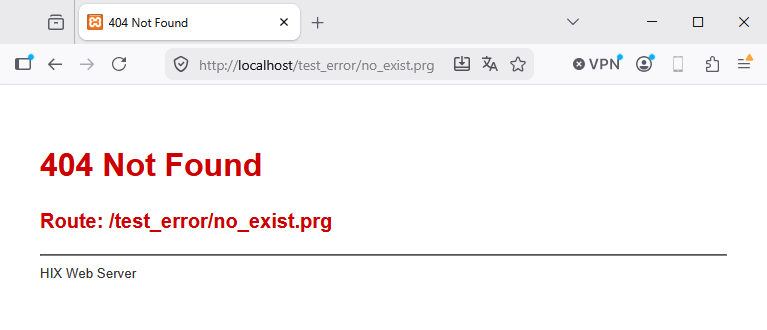
If a standard 404 occurs without this error defined, a basic internal screen is shown:
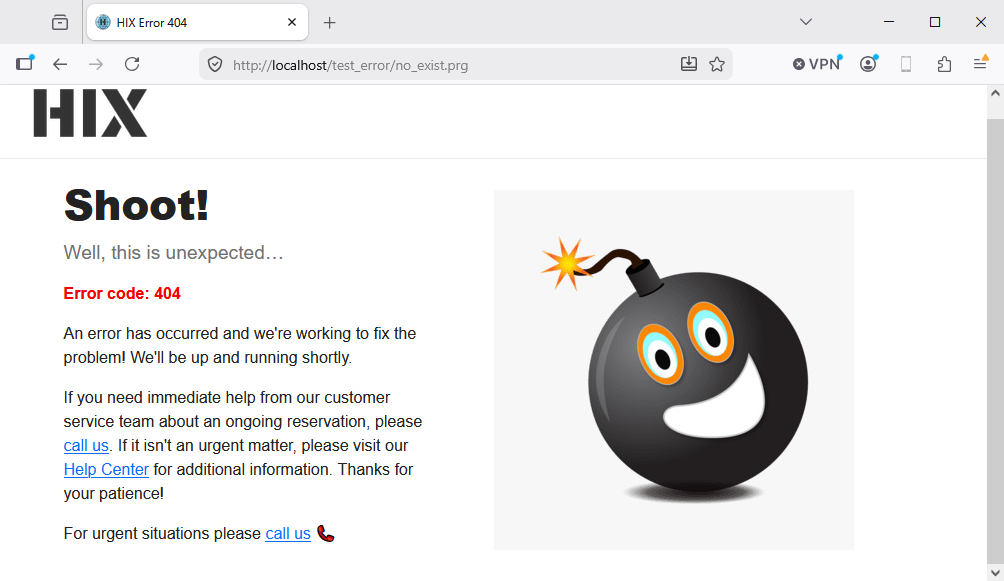
But if we define /errors/error_404.html with something like this:
<!DOCTYPE html>
<html lang="en">
<head>
  <meta charset="UTF-8">
  <meta name="viewport" content="width=device-width, initial-scale=1.0">
  <title>HIX Error 404</title>
  <link rel="icon" type="image/x-icon" href="https://raw.githubusercontent.com/carles9000/hix/main/resources/images/hix.ico">
  <link rel="stylesheet" href="https://cdn.jsdelivr.net/npm/bootstrap@5.3.3/dist/css/bootstrap.min.css">

  <style>
    :root {
      --hix-red: #F60000;
      --hix-dark: #222222;
      --hix-gray: #717171;
    }

    .mynav {
      padding: 20px 32px;
      border-bottom: 1px solid #ebebeb;
    }

    body {
      font-family: 'Nunito', -apple-system, BlinkMacSystemFont, sans-serif;
      background: #fff;
      color: var(--hix-dark);
      min-height: 100vh;
    }

    .error-title {
      font-size: 2.6rem;
      font-weight: 800;
      color: var(--hix-dark);
      margin-bottom: 10px;
    }
    .error-subtitle {
      color: var(--hix-gray);
      font-size: 1.2rem;
      font-weight: 400;
      margin-bottom: 14px;
    }

    .error-code {
      font-weight: 700;
      color: var(--hix-red);
    }

    .error-section {
      min-height: calc(100vh - 74px);
    }
    .error-text {
      padding: 10px 50px 10px 50px;
    }
  </style>
</head>
<body>

<nav class="mynav ">
  <img src="https://raw.githubusercontent.com/carles9000/hix/main/resources/images/hix.png" height="50" style="margin-right: 10px;">
</nav>


<div class="container error-section d-flex align-items-center fade-container">
  <div class="row w-100 align-items-center">

    <div class="col-md-6 error-text">
      <h1 class="error-title">Shoot!</h1>
      <p class="error-subtitle">Well, this is unexpected…</p>
      <p class="error-code">Error code: 404</p>
      <p class="error-body">
        An error has occurred and we're working to fix the problem! We'll be up and running shortly.
      </p>
      <p class="error-body">
        If you need immediate help from our customer service team about an ongoing reservation, please
        <a class="lnk" href="#">call us</a>.
        If it isn't an urgent matter, please visit our
        <a class="lnk" href="#">Help Center</a>
        for additional information. Thanks for your patience!
      </p>
      <p class="error-body">
        For urgent situations please <a class="lnk" href="#">call us</a> 📞
      </p>
    </div>

    <div class="col-md-6 illustration-col">
        <img src="/images/boom.jpg" style="margin-right: 10px;">
    </div>

  </div>
</div>

</body>
</html>
When the 404 error occurs, we would see this:
Web vs AJAX / JSON
In HIX_ShowError and HIX_HttpError, HIX_WantsJson(oReq) is called. This
function checks the Accept header (application/json) and the X-Requested-With
of the request, and decides:
- JSON → responds with
{ "error": "...", "code": NNN }with the corresponding HTTP status. Ignoreserrorsysanderror_XXX.html. - HTML → applies the full pipeline above (custom errorsys → internal dev/prod renderer →
error_XXX.htmlpages).
This means that:
- The same endpoint serving HTML will display the errorsys page.
- The same endpoint called from fetch() with Accept: application/json will receive JSON with error and code, with no HTML.
No configuration is needed: the detection is automatic.
Complete flow (visual recap)
Handler PRG throws uncaught exception
        │
        ▼
hix_worker_http.prg _HixHTTPProcessOne
        │  TRY / CATCH oError
        ▼
HIX_GetErrorHandler() != NIL ?
        │            │
       yes           no
        │            │
        ▼            ▼
   custom        HIX_ShowError(oError, oReq)
   handler            │
                     ├── log to errors.log
                     │
                     ├── WantsJson(oReq)? → respond JSON, done
                     │
                     ├── app.errorsys defined and file exists?
                     │       │
                     │      yes ─ render template
                     │       │        │       │
                     │       │       ok       fail
                     │       │       │         │
                     │       │       ▼         ▼
                     │       │   response   design error page
                     │       │
                     │      no
                     │       │
                     │       ▼
                     └── HIX_ErrorSys(oError)
                              │
                              ├── env=dev → HIX_ErrorSysDev
                              └── env=prod → HIX_ErrorSysProd
For semantic HTTP errors (404 in the router, 405 for method not allowed, etc.):
Router / dispatcher generates HTTP code
        │
        ▼
HIX_HttpError(oReq, nStatus, cDetail)
        │
        ├── WantsJson(oReq)? → JSON with {error, [detail]}
        │
        └── HIX_HttpErrorHtml(nStatus, cMsg, cDetail)
                │
                ├── www/errors/error_<nStatus>.html exists? → send file
                │
                └── minimal auto-generated HTML