🛑 Errorsys - Pantalla de error personalizada
Cuando una acción falla, HIX renderiza una página HTML 500. Por defecto
muestra la pantalla interna de HIX_ErrorSys.
Errorsys permite sustituir esa pantalla por tu propio template
.html, usando todo el motor de vistas HIX.
Configuración
Desde hix.json
Resolución del path
app.errorsys no lleva la carpeta errors/ en el JSON. HIX la añade en
función de hixstyle.enabled:
hixstyle.enabled |
Valor JSON | Path resuelto |
|---|---|---|
true |
errorsys.html |
<cRoot>/errors/errorsys.html |
true |
sub/errorsys.html |
<cRoot>/errors/sub/errorsys.html |
false |
errorsys.html |
<cRoot>/errorsys.html |
false |
sub/errorsys.html |
<cRoot>/sub/errorsys.html |
Con hixstyle.enabled=true, errors/ es una carpeta fija del layout
(como controllers/, views/, models/) y siempre se prefija.
<cRoot> viene de paths.root en hix.json (por defecto www).
Flujo:
1. Si el template existe y renderiza sin error → se envía al cliente.
2. Si el template falla al renderizar → se muestra la página Errorsys
Design Error (fondo rojo oscuro) con el error original + el error del
propio template.
3. Si el template no existe o queda vacío → cae al renderer interno
(HIX_ErrorSys, que a su vez respeta app.env).
El template errorsys.html
Es un template HIX estándar - mismos @args, {{ }} y reglas que
cualquier .html.
Recibe un único parámetro hErr (hash) con los campos del error:
@args hError

<!DOCTYPE html>
<html lang="es">
<head>
   <meta charset="UTF-8">
   <title>Error {{ hb_NToS(hError['subCode']) }}</title>
   <link href="https://cdn.jsdelivr.net/npm/bootstrap@5.3.3/dist/css/bootstrap.min.css" rel="stylesheet">
   <style>
      body { padding: 2em; font-family: system-ui, sans-serif; }
      pre  { background: #f4f4f4; padding: 1em; }
   </style>
</head>
<body>
   <h1 class="text-danger">Application Error (DEV)</h1>
   <hr>
   <table class="table table-bordered">
      <tr><th>Time</th><td>{{ dtoc(date()) + ' ' + time() }}</td></tr>
      <tr><th>Description</th><td>{{ hError['description'] }}</td></tr>
      <tr><th>Operation</th><td>{{ hError['operation'] }}</td></tr>
      <tr><th>Subsystem</th><td>{{ hError['subsystem'] }}</td></tr>
      <tr><th>File</th><td>{{ hError['file'] }}</td></tr>
      <tr><th>Line</th><td>{{ hb_NToS(hError['line']) }}</td></tr>
      <tr><th>HTTP</th><td>{{ hb_NToS(hError['subCode']) }}</td></tr>
   </table>

   <!-- Volcado bruto util en dev: -->
   <h3>Dump completo</h3>
   {!! _w( hError ) !!}
</body>
</html>
Si observas la linea {!! _w( hError ) !!} mostrara todo el contenido del hash
Cargo extendido para errores de vista
Cuando el error que llega a errorsys nace del motor de vistas (compile
fallido en @prg, directiva mal formada, template roto), HIX enriquece
hError["cargo"] con el diagnóstico completo del subsistema HIX_Compile*.
Esto es nuevo desde v2.4.0 — útil para mostrar en el template la línea
real del HTML con contexto.
Claves disponibles bajo hError["cargo"]:
| Clave | Contenido |
|---|---|
hCompile |
Hash entero del diagnóstico — { ok, phase, hrb, err, diagnostics, preambleLines } |
line |
Línea en el HTML del template (ya mapeada por aLineMap, no la línea en el .prg transpilado) |
line_code |
Snippet exacto de la línea que falló |
aCode |
Array con las líneas de contexto (anterior + culpable + siguiente) |
view_code |
Código HIX de categoría de error (9001 parser, 9002 transpile, 9004 execute, 9006 prg transpiled, 9010 load, 9011 load, 9009 recursion) |
module |
Módulo que lo originó (hix_view_transpile, hix_view, etc.) |
process |
Subsistema legible (Transpile, Execute, Prg transpiled, Load...) |
Dentro de hCompile["err"] el shape es canónico:
Si la fuente del error es runtime (no compile), err añade además
operation, args, subsystem, genCode, subCode, osCode, filename, stack, aStack.
Ejemplo — mostrar la línea culpable en el template
@args hError

@if ! Empty( hError["cargo"] ) .AND. hb_HHasKey( hError["cargo"], "hCompile" )
   <h2 class="text-danger">Fallo del motor de vistas</h2>
   <p><strong>Fase:</strong> {{ hError["cargo"]["hCompile"]["phase"] }}</p>
   <p><strong>Línea del template:</strong> {{ hb_NToS(hError["cargo"]["line"]) }}</p>
   <pre class="bg-light p-3">{{ hError["cargo"]["line_code"] }}</pre>
@endif
Nota sobre operation
El campo hError["operation"] para errores de vista ya no empieza por el
prefijo "line:" (formato legacy anterior a v2.4.0). Hoy es "line N"
puramente informativo. La fuente oficial del número de línea es
hError["cargo"]["line"] — un número Harbour listo para usar con
hb_NToS(). Si tu template custom todavía parsea "line:", cambia a
leer cargo["line"] directamente.
www/errors/error_XXX.html - páginas HTTP estáticas
Cuando el router o el dispatcher generan un error HTTP con código (404, 405,
403, 500…) llaman a HIX_HttpError(), que a su vez usa HIX_HttpErrorHtml.
Esta función busca:
- Si existe → se envía tal cual como respuesta HTML.
- Si no existe → se envía una página mínima autogenerada con el título del código y (opcionalmente) el detalle.
Ejemplo: para un 404, el fichero es www/errors/error_404.html.
5. Diferencia entre errorsys y error_XXX.html
errorsys |
error_XXX.html |
|
|---|---|---|
| Se dispara cuando… | El handler PRG lanza una excepción no capturada | El router/dispatcher devuelve un código HTTP concreto (404, 405, 403…) |
| Se procesa por… | HIX_ShowError() |
HIX_HttpErrorHtml() |
| Tipo de fichero | Template dinámico .html (motor de vistas) |
HTML plano |
| Recibe datos del error | Sí (@args hError) |
No |
Aplica app.env |
Sí (afecta al fallback interno) | No |
| Uno solo o varios | Un único template | Uno por código HTTP |
En resumen:
- errorsys = crashes de la lógica de la app.
- error_XXX.html = respuestas HTTP con código de error semántico.
Si se origina un 404 standard sin tener definido este error, se muestra una pantalla básica interna
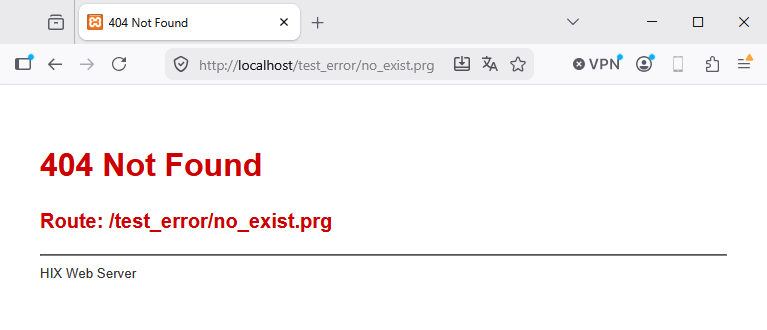
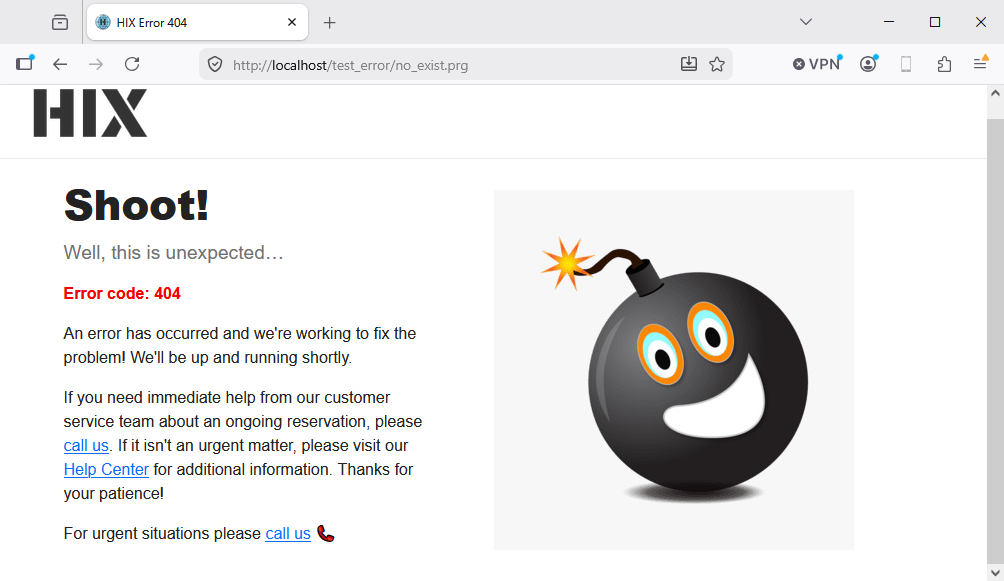
Pero si definimos /errors/error_404.html con algo parecido a esto:
<!DOCTYPE html>
<html lang="es">
<head>
  <meta charset="UTF-8">
  <meta name="viewport" content="width=device-width, initial-scale=1.0">
  <title>HIX Error 404</title>
  <link rel="icon" type="image/x-icon" href="https://raw.githubusercontent.com/carles9000/hix/main/resources/images/hix.ico">
  <link rel="stylesheet" href="https://cdn.jsdelivr.net/npm/bootstrap@5.3.3/dist/css/bootstrap.min.css">

  <style>
    :root {
      --hix-red: #F60000;
      --hix-dark: #222222;
      --hix-gray: #717171;
    }

    .mynav {
      padding: 20px 32px;
      border-bottom: 1px solid #ebebeb;
    }

    body {
      font-family: 'Nunito', -apple-system, BlinkMacSystemFont, sans-serif;
      background: #fff;
      color: var(--hix-dark);
      min-height: 100vh;
    }

    .error-title {
      font-size: 2.6rem;
      font-weight: 800;
      color: var(--hix-dark);
      margin-bottom: 10px;
    }
    .error-subtitle {
      color: var(--hix-gray);
      font-size: 1.2rem;
      font-weight: 400;
      margin-bottom: 14px;
    }

    .error-code {
      font-weight: 700;
      color: var(--hix-red);
    }

    .error-section {
      min-height: calc(100vh - 74px);
    }
    .error-text {
      padding: 10px 50px 10px 50px;
    }
  </style>
</head>
<body>

<nav class="mynav ">
  <img src="https://raw.githubusercontent.com/carles9000/hix/main/resources/images/hix.png" height="50" style="margin-right: 10px;">
</nav>


<div class="container error-section d-flex align-items-center fade-container">
  <div class="row w-100 align-items-center">

    <div class="col-md-6 error-text">
      <h1 class="error-title">Shoot!</h1>
      <p class="error-subtitle">Well, this is unexpected…</p>
      <p class="error-code">Error code: 404</p>
      <p class="error-body">
        An error has occurred and we're working to fix the problem! We'll be up and running shortly.
      </p>
      <p class="error-body">
        If you need immediate help from our customer service team about an ongoing reservation, please
        <a class="lnk" href="#">call us</a>.
        If it isn't an urgent matter, please visit our
        <a class="lnk" href="#">Help Center</a>
        for additional information. Thanks for your patience!
      </p>
      <p class="error-body">
        For urgent situations please <a class="lnk" href="#">call us</a> 📞
      </p>
    </div>

    <div class="col-md-6 illustration-col">
        <img src="/images/boom.jpg" style="margin-right: 10px;">
    </div>

  </div>
</div>

</body>
</html>
Al ocurrir el error 404 nos apareceria esto:
Web vs AJAX / JSON
En HIX_ShowError y HIX_HttpError se llama a HIX_WantsJson(oReq). Esa
función mira el header Accept (application/json) y el X-Requested-With
del request, y decide:
- JSON → responde
{ "error": "...", "code": NNN }con el status HTTP correspondiente. Ignoraerrorsysyerror_XXX.html. - HTML → aplica todo el pipeline anterior (errorsys custom → renderer
interno dev/prod → páginas
error_XXX.html).
Esto significa que:
- Un mismo endpoint que sirve HTML mostrará la página de errorsys.
- El mismo endpoint llamado desde fetch() con Accept: application/json
recibirá JSON con error y code, sin HTML.
No hay que configurar nada: la detección es automática.
7. Flujo completo (recap visual)
Handler PRG lanza excepción no capturada
        │
        ▼
hix_worker_http.prg _HixHTTPProcessOne
        │  TRY / CATCH oError
        ▼
HIX_GetErrorHandler() != NIL ?
        │            │
       sí            no
        │            │
        ▼            ▼
   handler       HIX_ShowError(oError, oReq)
   custom            │
                     ├── log a errors.log
                     │
                     ├── WantsJson(oReq)? → responde JSON, fin
                     │
                     ├── app.errorsys definido y fichero existe?
                     │       │
                     │      sí ── renderiza template
                     │       │        │       │
                     │       │      ok        falla
                     │       │       │         │
                     │       │       ▼         ▼
                     │       │   respuesta   design error page
                     │       │
                     │      no
                     │       │
                     │       ▼
                     └── HIX_ErrorSys(oError)
                              │
                              ├── env=dev → HIX_ErrorSysDev
                              └── env=prod → HIX_ErrorSysProd
Para errores HTTP semánticos (404 en el router, 405 en método no permitido, etc.):
Router / dispatcher genera código HTTP
        │
        ▼
HIX_HttpError(oReq, nStatus, cDetail)
        │
        ├── WantsJson(oReq)? → JSON con {error, [detail]}
        │
        └── HIX_HttpErrorHtml(nStatus, cMsg, cDetail)
                │
                ├── www/errors/error_<nStatus>.html existe? → envía fichero
                │
                └── HTML mínimo autogenerado