🛑 Errorsys - Pagina di errore personalizzata
Quando un'action fallisce, HIX renderizza una pagina HTML 500. Di default
mostra la schermata interna HIX_ErrorSys.
Errorsys ti permette di sostituire quella schermata con un template
.html tuo, sfruttando l'intero view engine di HIX.
Configurazione
Da hix.json
Risoluzione del path
app.errorsys non include la cartella errors/ nel JSON. HIX la aggiunge
in base a hixstyle.enabled:
hixstyle.enabled |
Valore JSON | Path risolto |
|---|---|---|
true |
errorsys.html |
<cRoot>/errors/errorsys.html |
true |
sub/errorsys.html |
<cRoot>/errors/sub/errorsys.html |
false |
errorsys.html |
<cRoot>/errorsys.html |
false |
sub/errorsys.html |
<cRoot>/sub/errorsys.html |
Con hixstyle.enabled=true, errors/ è una cartella di layout fissa
(come controllers/, views/, models/) ed è sempre prefissata.
<cRoot> proviene da paths.root in hix.json (default: www).
Flusso:
1. Se il template esiste e renderizza senza errori → viene inviato al client.
2. Se il template fallisce nella renderizzazione → viene mostrata la pagina Errorsys Design Error
(sfondo rosso scuro) con l'errore originale più l'errore del template.
3. Se il template non esiste o è vuoto → fallback al renderer interno
(HIX_ErrorSys, che a sua volta rispetta app.env).
Il template errorsys.html
È un template HIX standard — stesso @args, {{ }} e regole di qualsiasi
file .html.
Riceve un singolo parametro hError (hash) con i campi dell'errore:
@args hError

<!DOCTYPE html>
<html lang="en">
<head>
   <meta charset="UTF-8">
   <title>Error {{ hb_NToS(hError['subCode']) }}</title>
   <link href="https://cdn.jsdelivr.net/npm/bootstrap@5.3.3/dist/css/bootstrap.min.css" rel="stylesheet">
   <style>
      body { padding: 2em; font-family: system-ui, sans-serif; }
      pre  { background: #f4f4f4; padding: 1em; }
   </style>
</head>
<body>
   <h1 class="text-danger">Application Error (DEV)</h1>
   <hr>
   <table class="table table-bordered">
      <tr><th>Time</th><td>{{ dtoc(date()) + ' ' + time() }}</td></tr>
      <tr><th>Description</th><td>{{ hError['description'] }}</td></tr>
      <tr><th>Operation</th><td>{{ hError['operation'] }}</td></tr>
      <tr><th>Subsystem</th><td>{{ hError['subsystem'] }}</td></tr>
      <tr><th>File</th><td>{{ hError['file'] }}</td></tr>
      <tr><th>Line</th><td>{{ hb_NToS(hError['line']) }}</td></tr>
      <tr><th>HTTP</th><td>{{ hb_NToS(hError['subCode']) }}</td></tr>
   </table>

   <!-- Dump grezzo utile in dev: -->
   <h3>Dump completo</h3>
   {!! _w( hError ) !!}
</body>
</html>
Se osservi la riga {!! _w( hError ) !!}, mostrerà tutti i contenuti dell'hash.
Cargo esteso per errori di vista
Quando l'errore che raggiunge errorsys nasce dal motore di viste (compile
fallito in @prg, direttiva malformata, template rotto), HIX arricchisce
hError["cargo"] con il diagnostico completo del sottosistema HIX_Compile*.
Questa funzionalità è disponibile da v2.4.0 — utile per mostrare nel template
la riga reale dell'HTML con contesto.
Chiavi disponibili sotto hError["cargo"]:
| Chiave | Contenuto |
|---|---|
hCompile |
Hash diagnostico completo — { ok, phase, hrb, err, diagnostics, preambleLines } |
line |
Riga nel template HTML (già mappata via aLineMap, non la riga nel .prg transpilato) |
line_code |
Snippet esatto della riga che ha fallito |
aCode |
Array con le righe di contesto (prima + riga errore + dopo) |
view_code |
Codice categoria errore HIX (9001 parser, 9002 transpile, 9004 execute, 9006 prg transpiled, 9010 load, 9011 load, 9009 recursion) |
module |
Modulo di origine (hix_view_transpile, hix_view, ecc.) |
process |
Sottosistema leggibile (Transpile, Execute, Prg transpiled, Load...) |
All'interno di hCompile["err"] il formato è canonico:
Se la fonte dell'errore è runtime (non compile), err aggiunge inoltre
operation, args, subsystem, genCode, subCode, osCode, filename, stack, aStack.
Esempio — mostrare la riga che ha fallito nel template
@args hError

@if ! Empty( hError["cargo"] ) .AND. hb_HHasKey( hError["cargo"], "hCompile" )
   <h2 class="text-danger">Errore del motore di viste</h2>
   <p><strong>Fase:</strong> {{ hError["cargo"]["hCompile"]["phase"] }}</p>
   <p><strong>Riga del template:</strong> {{ hb_NToS(hError["cargo"]["line"]) }}</p>
   <pre class="bg-light p-3">{{ hError["cargo"]["line_code"] }}</pre>
@endif
Nota su operation
Il campo hError["operation"] per gli errori di vista non inizia più con il
prefisso legacy "line:" (formato precedente a v2.4.0). Ora è "line N"
puramente informativo. La fonte ufficiale del numero di riga è
hError["cargo"]["line"] — un numero Harbour pronto all'uso con hb_NToS().
Se il tuo template custom analizza ancora "line:", cambia a leggere
cargo["line"] direttamente.
www/errors/error_XXX.html - pagine di errore HTTP statiche
Quando il router o il dispatcher genera un errore HTTP con un codice (404, 405,
403, 500…), chiama HIX_HttpError(), che a sua volta usa HIX_HttpErrorHtml.
Questa funzione cerca:
- Se esiste → viene inviato così com'è come risposta HTML.
- Se non esiste → viene inviata una pagina minimale auto-generata con il titolo del codice e (opzionalmente) il dettaglio.
Esempio: per un 404, il file è www/errors/error_404.html.
Differenza tra errorsys e error_XXX.html
errorsys |
error_XXX.html |
|
|---|---|---|
| Si attiva quando… | Il PRG handler genera un'eccezione non catturata | Il router/dispatcher restituisce uno specifico codice HTTP (404, 405, 403…) |
| Elaborato da… | HIX_ShowError() |
HIX_HttpErrorHtml() |
| Tipo di file | Template dinamico .html (view engine) |
HTML puro |
| Riceve dati dell'errore | Sì (@args hError) |
No |
Applica app.env |
Sì (influisce sul fallback interno) | No |
| Uno o molti | Template singolo | Uno per codice HTTP |
In sintesi:
- errorsys = crash nella logica dell'app.
- error_XXX.html = risposte HTTP con codici di errore semantici.
Se si verifica un 404 standard senza questo errore definito, viene mostrata una schermata interna basilare:
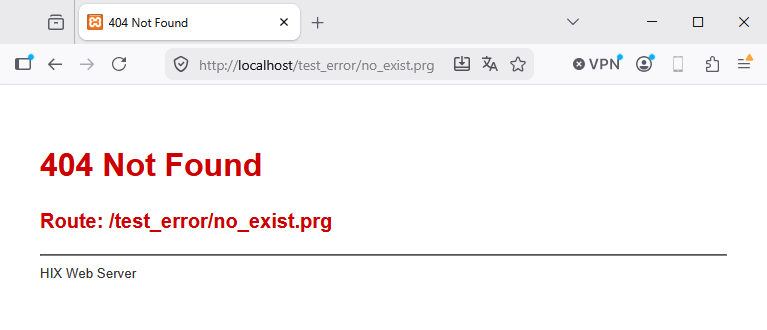
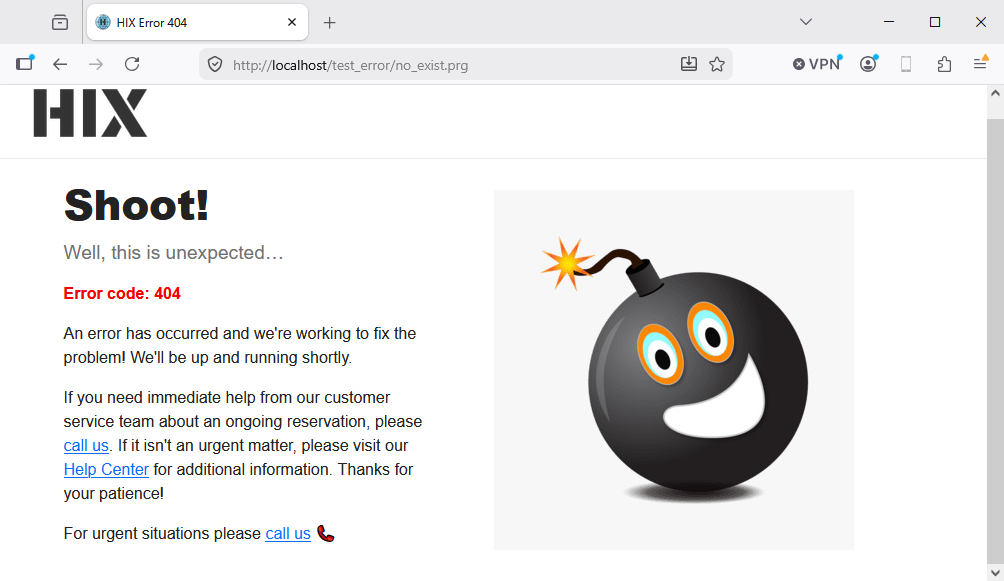
Ma se definiamo /errors/error_404.html con qualcosa come questo:
<!DOCTYPE html>
<html lang="en">
<head>
  <meta charset="UTF-8">
  <meta name="viewport" content="width=device-width, initial-scale=1.0">
  <title>HIX Error 404</title>
  <link rel="icon" type="image/x-icon" href="https://raw.githubusercontent.com/carles9000/hix/main/resources/images/hix.ico">
  <link rel="stylesheet" href="https://cdn.jsdelivr.net/npm/bootstrap@5.3.3/dist/css/bootstrap.min.css">

  <style>
    :root {
      --hix-red: #F60000;
      --hix-dark: #222222;
      --hix-gray: #717171;
    }

    .mynav {
      padding: 20px 32px;
      border-bottom: 1px solid #ebebeb;
    }

    body {
      font-family: 'Nunito', -apple-system, BlinkMacSystemFont, sans-serif;
      background: #fff;
      color: var(--hix-dark);
      min-height: 100vh;
    }

    .error-title {
      font-size: 2.6rem;
      font-weight: 800;
      color: var(--hix-dark);
      margin-bottom: 10px;
    }
    .error-subtitle {
      color: var(--hix-gray);
      font-size: 1.2rem;
      font-weight: 400;
      margin-bottom: 14px;
    }

    .error-code {
      font-weight: 700;
      color: var(--hix-red);
    }

    .error-section {
      min-height: calc(100vh - 74px);
    }
    .error-text {
      padding: 10px 50px 10px 50px;
    }
  </style>
</head>
<body>

<nav class="mynav ">
  <img src="https://raw.githubusercontent.com/carles9000/hix/main/resources/images/hix.png" height="50" style="margin-right: 10px;">
</nav>


<div class="container error-section d-flex align-items-center fade-container">
  <div class="row w-100 align-items-center">

    <div class="col-md-6 error-text">
      <h1 class="error-title">Shoot!</h1>
      <p class="error-subtitle">Well, this is unexpected…</p>
      <p class="error-code">Error code: 404</p>
      <p class="error-body">
        An error has occurred and we're working to fix the problem! We'll be up and running shortly.
      </p>
      <p class="error-body">
        If you need immediate help from our customer service team about an ongoing reservation, please
        <a class="lnk" href="#">call us</a>.
        If it isn't an urgent matter, please visit our
        <a class="lnk" href="#">Help Center</a>
        for additional information. Thanks for your patience!
      </p>
      <p class="error-body">
        For urgent situations please <a class="lnk" href="#">call us</a> 📞
      </p>
    </div>

    <div class="col-md-6 illustration-col">
        <img src="/images/boom.jpg" style="margin-right: 10px;">
    </div>

  </div>
</div>

</body>
</html>
Quando si verifica l'errore 404, vedremmo questo:
Web vs AJAX / JSON
In HIX_ShowError e HIX_HttpError viene chiamata HIX_WantsJson(oReq). Questa
funzione controlla l'header Accept (application/json) e l'X-Requested-With
della request, e decide:
- JSON → risponde con
{ "error": "...", "code": NNN }con il corrispondente status HTTP. Ignoraerrorsysederror_XXX.html. - HTML → applica l'intera pipeline sopra (errorsys personalizzato → renderer interno dev/prod → pagine
error_XXX.html).
Questo significa che:
- Lo stesso endpoint che serve HTML mostrerà la pagina errorsys.
- Lo stesso endpoint chiamato da fetch() con Accept: application/json riceverà JSON con error e code, senza HTML.
Nessuna configurazione necessaria: il rilevamento è automatico.
Flusso completo (riepilogo visuale)
Handler PRG genera un'eccezione non catturata
        │
        ▼
hix_worker_http.prg _HixHTTPProcessOne
        │  TRY / CATCH oError
        ▼
HIX_GetErrorHandler() != NIL ?
        │            │
       yes           no
        │            │
        ▼            ▼
   custom        HIX_ShowError(oError, oReq)
   handler            │
                      ├── scrive su errors.log
                      │
                      ├── WantsJson(oReq)? → risponde JSON, fine
                      │
                      ├── app.errorsys definito e file esiste?
                      │       │
                      │      yes ─ renderizza template
                      │       │        │       │
                      │       │       ok       fail
                      │       │       │         │
                      │       │       ▼         ▼
                      │       │   risposta  design error page
                      │       │
                      │      no
                      │       │
                      │       ▼
                      └── HIX_ErrorSys(oError)
                               │
                               ├── env=dev → HIX_ErrorSysDev
                               └── env=prod → HIX_ErrorSysProd
Per errori HTTP semantici (404 nel router, 405 per metodo non consentito, ecc.):
Router / dispatcher genera un codice HTTP
        │
        ▼
HIX_HttpError(oReq, nStatus, cDetail)
        │
        ├── WantsJson(oReq)? → JSON con {error, [detail]}
        │
        └── HIX_HttpErrorHtml(nStatus, cMsg, cDetail)
                │
                ├── www/errors/error_<nStatus>.html esiste? → invia file
                │
                └── HTML minimale auto-generato