🛠️ Dev mode / Prod mode
HIX distinguishes two execution environments based on env:
dev— local development. Everything facilitates debugging: detailed errors, no asset caching, immediate template reloading.prod— production. Everything facilitates performance and security: generic errors, aggressive caching, templates compiled once.
Switching modes is a single line — and it alters the behavior of half the framework.
hix.json
"app" : {
  "env" : "dev"          ◀───── Local: F5 reloads, full traceback, no cache
  "env" : "prod"         ◀───── Real server: generic 500, assets cached 1h
}
What changes between modes
| Behavior | dev |
prod |
|---|---|---|
| Error pages | Detailed HTML with stack + source code | Generic 500 (or minimal errorsys template) |
Cache-Control for assets |
no-store — browser does not cache |
public, max-age=3600 — 1 hour |
Views .html |
Retranspile if file changes | In-memory cache, no recheck |
errors.log |
Same in both — always written | Same |
Traces _d() |
Visible if app.debug = true |
Usually off |
| Admin panel | Access if lAdminEnabled=.T. |
Better to disable or restrict by IP |
The two observable from the client differences are error pages and caching. The rest are server-side optimizations.
Error pages
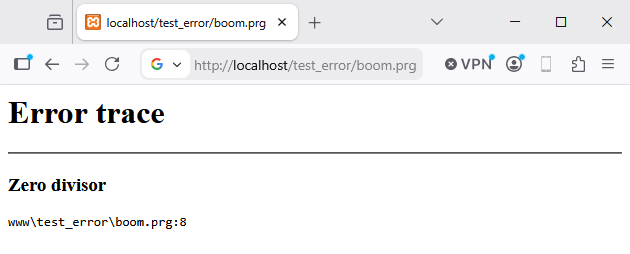
In dev
HIX_ErrorSys renders a large HTML with an error fields table: description, subsystem, operation, file, line, and source code around the failing line highlighted in red.
┌─────────────────────────────────┐
│  View Error                     │
├─────────────────────────────────┤
│  Description: undefined var X   │
│  Subsystem  : BASE              │
│  File       : views/login.html  │
│  Line       : 23                │
│                                 │
│    0020  <form action="..">     │
│    0021    <input name="user">  │
│    0022    <input name="pass">  │
│ => 0023  {{ X + 1 }}            │
│    0024    <button>OK</button>  │
│    0025  </form>                │
└─────────────────────────────────┘
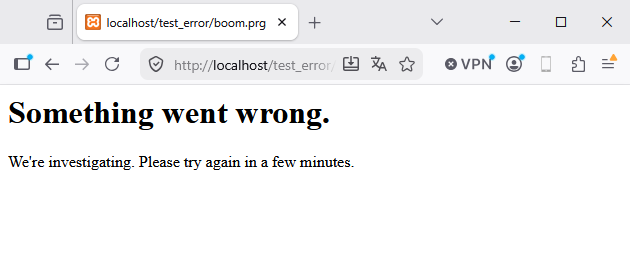
In prod
┌─────────────────────────────────┐
│  500 - Internal Server Error    │
└─────────────────────────────────┘
If you configure errorsys with your own template, prod mode uses your page, but with the information you decide to expose:
@args hErr

@if UIsProd()
  <h1>Something went wrong.</h1>
  <p>We're investigating. Please try again in a few minutes.</p>
@else
  <h1>{{ UHtmlEncode(hErr["description"]) }}</h1>
  <pre>{{ UHtmlEncode(hErr["file"]) }}:{{ hb_NToS(hErr["line"]) }}</pre>
@endif
DEV
PROD
Asset caching
The dispatcher emits different Cache-Control based on cEnv for files served from www/:
| Mode | Cache-Control |
|---|---|
dev |
no-store — reload every time |
prod |
public, max-age=3600 — 1 hour |
This applies to CSS, JS, images, and fonts. In dev, you modify app.css and a Ctrl+F5 brings it instantly; in prod, the browser reuses it for an hour without making a GET request.
Templates .html
| Mode | Behavior |
|---|---|
dev |
Engine retranspiles if file changed (mtime) |
prod |
Compiles first time, caches, does not recheck |
In production, edit and restart the server — there is no hot-reload for templates.
Different logs per environment
IF UIsDev()
   HIX_LoggerInit( "logs/hix.log", HIX_LOG_DEBUG, .T. )    // verbose + console
ELSE
   HIX_LoggerInit( "logs/hix.log", HIX_LOG_INFO,  .F. )    // file only, info+
ENDIF
CSRF / stricter session in prod
IF UIsProd()
   HIX_MwSessionSetup( "HIXSID", 1800, 60, "file", ".sessions/" )    // 30 min
ELSE
   HIX_MwSessionSetup( "HIXSID", 86400, 60, "memory" )               // 1 day in RAM
ENDIF
Checklist before moving to prod
app.env = "prod"inhix.json.server.ssl = true+ valid certificates (Let's Encrypt).app.debug = falseand log level set toinfoorwarn.paths.errors = ".logs"(or a directory outside the webroot).- Admin panel disabled or behind IP whitelist.
- CORS with specific origins, not
"*". - Rate limit active on sensitive endpoints (
/login, ...). - Session cookie short (30–60 min) and
lSessionCrypt=.T.if file-based.